Showing posts with label Breeds of Hunting Dogs List. Show all posts

Thursday, 14 July 2016

Bred for Looks, Born to Suffer

Tomorrow, if you're walking down Clarges St in London's Mayfair and hear strange popping noises, it will be Kennel Club staff's heads exploding in response to the RSPCA's new  Bred for Looks, Born to Suffer campaign, launched today with the above ad in the Mail on Sunday.

I have to confess to feeling a little uncomfortable about some aspects of the campaign myself.

I'm fine with the ad above as I feel really strongly that we should return pugs to an earlier version where they had longer muzzles. In fact, we've just returned from filming with world brachycephalic expert Professor Gerhard Oechtering in Leipzig who showed us the damage that has been done, internally, by breeding for such a flat face (see below). It is so much more than most people imagine - and it is heart-breaking to see what we've done to this characterful little dog that bears its fate with such cheerful stoicism.

I'm OK, too, with what the RSPCA's new campaign says on the main campaign page, although I know others will be hyperventilating at the singling out of pedigree dogs as opposed to those dreadful designer crossbreeds.

But I did wince at this page... which starts:
The way that dogs are bred today, in order to win shows, is having a huge impact on their health and welfare. This is why we’ve launched our Born to Suffer campaign which seeks an end to the breeding of dogs based on looks.
 

But it's not just show dogs that may be suffering. Many pedigree dogs never appear in shows, but many are bred by breeders who want to produce show-winning animals, and who sell their surplus dogs as pets.

And the reason I winced is that, although it's true to say that it's the show-scene that often stamps the current 'look' on a breed, there are loads of breeders breeding purely for the pet marked who are producing dogs that are no better (in fact in some instances worse - pet-bred Shar-pei, for instance, are usually much more wrinkled than their show-bred cousins).  In other words, I think to single out show breeders in this instance is unfair. I know, I know, people will no doubt yelp that that is exactly what I do. But I wouldn't have done if I had been copywriting the RSPCA campaign. 

Here, by the way, is a a 'grab' from the footage we shot of the inside of a pet-bred pug's mouth when we filmed in Leipzig. Pugs have the same number of teeth as a dog with a longer muzzle and this is nature's attempt at accommodating them.

The demise of the Great Dane


The two line-drawings at the top are taken from British Dogs, Their Points, Selection, And Show Preparation by W.D Drury, published in 1903. They formed part of the Great Dane breed standard adopted by the Great Dane Club (UK) at the time. The two pictures underneath are of modern show dogs (on the left, UK; on the right a French champion).

One hundred years ago, the breed looked like this...

b.1899
Today we see dogs like this (below) in the show-ring. It is not every dog in every ring, but it is in sufficient number to sound the alarm.


Can anyone truly think that this is any kind of an improvement on the dog of 100 years ago?

In France, particularly, the rise of what's often called the Euro-Dane is turning the breed into a Neapolitan Mastiff - a grotesque, floppy-flewed caricature of what the breed used to be.


© Falkhor Babinosaure

Better body... but who on earth thought that head was a good idea?

This is not just an aesthetic issue. Floppy flews are dysfunctional. There is no benefit to a bigger/heavier ear leather. Over-sized bodies elevate the risk of joint issues. Many Dane eyes are wincingly painful, too - both for the dogs and for any observer not subsumed into a breed culture that makes them oblivious to the every-second-of-the-waking-daydiscomfort dogs like this endure.

UK showdog
Almost every day I hear a breeder of a breed with dreadful eyes (Danes, Clumbers, Neapolitans, Bassets) justify the breeding of these dogs by telling me it's a minor issue compared to other bigger breed issues. But it isn't - not for the dog. If you think it's OK, please poke yourself in the eye with a dirty finger and leave the conjunctivitis untreated for a few days.

UK showdog
Then there's the swingeing longevity, or rather lack of it. Average life expectancy today? Just six years old, with cancer being the biggest cause of death, followed by bloat/digestive issues, heart disease, joint problems and spinal disease (source: Finnish KC database).  And it is not just Finnish Danes. The KC's 2004 health survey found a median age of death for the breed of 6 yrs 6 months.

I continue to be at a loss as to why poor longevity in Danes and many other breeds doesn't trigger a massive effort by Kennel Clubs and breeders to do something to tackle it. Instead, breeders seem to claim it as some kind of breed feature, something they accept as one of those things; not their fault... not much they can do about it.

This is not true. They can do something about it. 

I have a soft spot for Danes because I grew up with two of them. Neither of them were any great shakes. One had a digestive problem that kept him rake thin. The other was a nice-but-dim-Tim who died young of a reason lost in time. This is me with him when he was a pup at a fun dog-show in the 1970s (we came second in the dog-with-the-longest-tail class).


I remember being concerned about his slightly saggy eyes at the time; but the ectropion (as I now know it to be) was very minor compared to what you see in today's show dogs. They also used to be dry-mouthed; whereas today most Dane owners have to deal with globs of viscous slobber that makes the breed increasingly undesirable as a family dog.


Here's another beautiful Dane head from the 1970s compared to a modern UK show dog.


Many of today's Great Danes are a disgrace, with mostly no purpose other than to be an oversized, slobbery mess. They are a travesty of what they used to be.

Here's one of the reasons why... take a look at the points system that was in place for many years in the UK. Although no longer used in the UK, it helped set the agenda.  Most important? The head and the size. Least important, less so even than the tail or feet? Overall condition.


Want to know what do to do about it?

• international breed database that records health data and is open to all

• make death reporting (age and cause) a priority

• store semen when dogs are young and use it if they prove to be healthy into later years

• revise the points system (where still in use) to make condition/activity more important.

• rewrite the breed standard to reduce the minimum weight; introduce a maximum height and weight.

• worldwide symposium aimed at uniting breeders in a breed conservation plan

• breed them smaller. As with many giant breeds, there has been a creeping increase in size. Today's Danes are massive - much bigger than they used to be.

Big dogs die young. Bigger dogs die younger.

And bigger dogs with deep chests die even younger.

(The bloat situation is so bad in the breed that many breeders and owners do a pre-emptive gastropexy.)

This is also, perhaps, where the new International Partnership for Dogs (IPFD) could play a role. If every signed-up KC contributed pictures of their top-winning dogs every year, the side-by-side comparisons would alert to the different types, prompting discussion that would hopefully help reign in excess.

Additionally, in the UK, the Kennel Club now needs to make this breed a Category Threebreed - one whose conformation demands urgent action.

To finish with an eye-cleanser,  I should say that there are still some nice show Danes around - this is the Dane that took Best of Breed at Westminster this year. The dog is too big, and his neck is too long, but the WKC winner is much more moderate than some of the travesties we are seeing on this side of the pond.


And how about this... a Dane in the Finnish show-ring. Beautiful - and pretty typical of the breed in Finland; a country so often ahead of the rest of the world when it comes to the health of purebred dogs.


So let's see more of them.. and a lot less of these.

© Falkhor Babinosaure

BREAKING NEWS: KC survey reveals apocalyptic drop in purebred dog longevity


There has been a catastrophic decline in purebred dog longevity, according to the results of a long-awaited health survey released by the Kennel Club yesterday.

It has taken the KC over a year to report on its 2014 health survey - the largest ever survey of its kind - and a follow-up to its 2004 survey.  It makes for grim reading.

Across all the breeds, median longevity has dropped by 11 per cent in a decade. Kennel Club registered dogs now live on average to just 10 years old - down from 11yrs 3 months in 2004.

Some breeds have seen jaw-dropping decreases compared to the 2004 survey.

Bull Terriers now die on average at just seven years old - down from 10yrs in 2004 (a 30% decrease)

Beagles: down from 12yrs 8mths to 10 yrs old.

Dobermanns: down from 10yrs 6mths to 8 yrs today.

Dalmatians: down from 12yrs 6mths in 2004 to 11yrs now.

Border Terriers: down from 14yrs to 12yrs

Irish Wolfhounds: down from 7yrs to 6.5yrs

Rhodesian Ridgebacks: down from 11yrs to 9yrs.

Bulldogs: down from 6yrs 3mths to an even worse 6yrs.

Boxers: now living to 9yrs, compared to 10yrs 3mths in 2004.

Cavaliers: now dying at 10, as opposed to 11yrs 5mths in 2004.

Irish Setters: now dead on average at 11 - down from 12 in 2004.

Whippets: down from 12yrs 4mths to 10yrs.

Even the nation's favourite dog, the Labrador,  is dying younger - at 11yrs old compared to 12yrs 3mths in 2004.

I found a few breeds with modest increases: Flatcoats now live to 10yrs - 2 months longer than they did in 2004. Great Danes died at 6yrs 6mths in 2004 and now survive on average to 7yrs. The Old English Sheepdog now lives 3 months longer (11yrs as opposed to 10yrs 9mths). Bernese Mountain Dog longevity has stayed the same at 8.

But, at this rate, many Kennel Club breeds could be extinct in 100 years' time.

It is a disappointing that the KC chose not to mention this decline in the release accompanying the survey findings (see here).

Now don't get me wrong  -  it is genuinely great that the KC is doing these surveys; it just needs to be honest and not play down negative findings.

I remember how the KC maintained both in and after Pedigree Dogs Exposed that 90 per cent of KC registered dogs were "perfectly healthy" - despite its own survey (the 2004) one finding that almost 40 per cent of KC dogs suffered from one or more health issues.

This time, as before, the KC reports that the main cause of death is old age - reassuring until you look at the actual figures.  In 2004, 17.8% of dogs died from old age. In 2014, it dropped to 13.78%.

Headline: more than 85% of KC registered dogs today do not make it to old age - and almost all die, or are put to sleep, because of disease.


(Trauma/accidents/behavioural issues account for only a tiny percentage of deaths reported.)

The new findings shouldn't be a huge surprise. Despite frequent claims by many that dogs are living longer today than ever before - it has been pretty obvious that an increasing number of breeds are tottering on the brink of viability. It does not, however, make the findings any less heartbreaking for everyone who loves dogs.

The reason for the decline? Closed gene pools... obsession with purity.. popular sires.. dogs being judged on looks not health... and the erroneous belief that breeders can health-test their way out of trouble.

Now there's some wiggle-room in this survey for those who want to question the results.  There were far fewer deaths reported than in the 2004 survey.  And while the 2004 survey was sent out to breed clubs; the 2014 survey was sent out more widely to owners of KC-registered dogs. This means that the surveyed populations were not identical.
When I talked to the KC about the survey in June 2014, though, they were at pains to point out that it would be backwards-compatible with the 2004 survey. 

This is important because, as the KC itself said when the 2004 survey findings were released: "Data gathered from this survey will provide baseline information against which the success of future control schemes can be measured."

The KC has, in fact, withheld certain data that it feels is not statistically significant in the 2014 survey  - e.g. if fewer than 30 deaths have been reported in a breed; hence, rather disappointingly, why there is no median death data reported for many of the current breeds of concern: Pugs, French Bulldogs, Bostons, Dogue de Bordeaux and Neapolitan Mastiff. (Although, frankly, it is telling that so few owners/breeders of these breeds, who these days so often spout a commitment to health, contributed to such a well-publicised survey.)

The Kennel Club needs to encourage these breed clubs to run ongoing health surveys to monitor longevity in these breeds, as well as to find a way to encourage more people to contribute to their next survey (which will presumably be in 2024).

In the meantime, the current findings should be a call to arms. There are some breeds today that are little more than ghosts of what they were.

But I suspect we'll get the usual denial.. the deflecting blame on to vaccines, commercial dog food, puppy millers, vets or big pharma... 

And all the while the dogs we purport to love so fiercely will continue to wither and wane.

GSDs at Crufts 2016: the continuing travesty


The above clip was all Channel 4 showed of the GSD in the Group judging at Crufts on television tonight. It was the only dog in the Group that wasn't shown moving.

The only explanation, surely, is that the Kennel Club - which claims no editorial control  over the TV footage - vetoed it being shown, embarrassed at the state of the dog.

The bitch, Cruaghaire Catoria, really was a shocker, and very stressed by the occasion. She was nervy in the breed ring earlier in the day, too.

But of course it wasn't just her temperament.

Below is footage of her winning Best of Breed at Crufts today - alongside the just-as-awful Best Dog,  Ch Yupp Vom Hammelsbacher Hof.


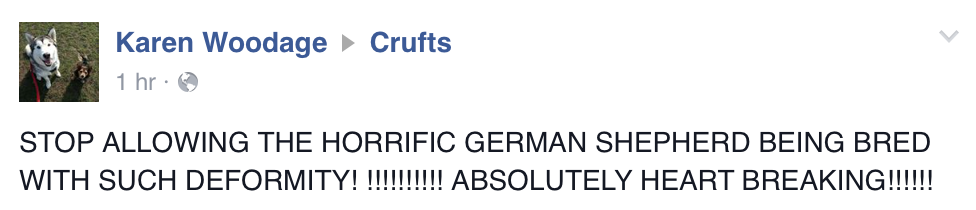
The Crufts Facebook page is being bombarded with complaints.


It is just heart-breaking. 

How much longer can we stand by and not insist that something is done about the state of this breed?

Eukanuba... what were you *thinking*??


As some of you will know, I have recently set up CRUFFA - the Campaign for the Responsible Use of Flat-Faced Animals (in advertising and the media).  Cruffa's aim is to persuade companies/organisations to not use brachycephalics as a selling tool for their products/services/events - and where only a brachy will do to encourage the use of dogs/cats with more moderate features. 

Cruffa is not much more than a Facebook page at the moment and in truth I have had little time to do much, but there's been a fantastic response, with pledges of support (and/or a commitment to not use stock photographs of brachycephalics where a more normal dog/cat would do) already in from:

Dogs Trust
RSPCA
PDSA
Dogs Today Magazine
Total Pet Publishing
International Cat Care
Dog Breeding Reform Group


Registrations of the extreme brachycephalics are at an all-time high (one in seven dogs registered with the Kennel Club is now a Pug, French Bulldog of a Bulldog - compared to one in 50 ten years ago). 

These three breeds in particular are being used to flog everything from car insurance to mobile phone networks, contributing to their demand and the 'normalisation' of features that are anything but normal - flat faces, over-large eyes, pinched nostrils, obesity. Particularly worrying is the amount of ads/editorial use in the mainstream and online media which feature brachy dogs "smiling" but whose drawn-back + up lips betray that they are hot and/or are struggling to breathe.


But I digress.

I was really shocked to see the GSD above on this Eukanuba dog-food.  And they've also used the same dog, flipped, in this branding. Note the caption on the dog's hips...what irony.


GSDs do not come under Cruffa's remit but I thought it would be good to use the same tools Cruffa is using (personal communication and social media pressure) to encourage Eukanuba to commit to changing the image of this dog to one that is not struggling to stand or cow-hocked.

You can tweet them @eukanuba.

Here is their Facebook page: https://www.facebook.com/Eukanuba/

As you'll see on the pack, Eukanuba also carries a Kennel Club logo boasting that they are "partners in nutrition", so lobbying the KC via its Facebook page or Twitter - @KCLovesDogs - should also be effective.

I have already posted/tweeted to the above, and the more voices/comments received, the more likely it is that they will commit to changing the image.

With a bit of luck to one that looks like this.


Or this.


*****UPDATE*****

Delighted to report that I've received this from Eukanuba this evening (22/6/16). Thank you to everyone who commented on the links above to help secure this commitment - and well done to Eukanuba for the quick response.

Hi Jemima  
At Eukanuba, we are pet owners first and foremost and care deeply about the animals we serve. 
To offer some insight and background to the current image of the German Shepherd Dog; Spectrum Brands only acquired the Eukanuba brand in Europe on 1 January 2015 from its previous owner Procter & Gamble. The current German Shepherd Dog image was chosen by Procter & Gamble in the United States back in 2013 and was then also applied to the European packaging. At that time no-one from Spectrum Brands was obviously involved in the brand or choice of images that would be shown on the packaging.  
Moving forward, we are reviewing all assets that we acquired from Procter & Gamble including the packaging of our German Shepherd Breed Specific formula. We have recognised that the image is not a fair representation of the ideal conformation of the German Shepherd Dog. Therefore we will look to change this image to be in line with the ideal representation of the breed as part of our future asset review. 
 
The Eukanuba Team

Monday, 25 April 2016

What is the best dog for hunting mainly Pheasants, Quail, and Grouse

here you can let know about best Dog for Hunting

best dog for hunting

I do a lot of bird hunting with dogs. No quail or doves but everything else on the menu plus waterfowl. I have two labs and a french brittany. They work very well together and individually. For versatility I really don't think you can beat a lab. I enjoy hunting over a flushing dog much more than the pointer, but that's just me. Hunting uplands over pointers might be more "productive" in the sense of filling the bag, but I find hunting over flushers to be more exciting.

best dog for hunting


I have been training dogs for more than forty years and have never owned a shock collar or a beeper. However, I do spend a LOT of time in the field with my dogs. And I accept that there is going to be a lot of blown opportunities when training a new dog. I just keep saying to myself, "Well, that's one more I don't have to clean tonight." And, as I always say, the longer it takes me to fill my limit, the longer I'm in the field. And the longer I am in the field, the happier I am.

I find many of the pointers are too hard-headed and high-strung. Not infrequently they are also poor retrievers (and that's all you'd want for dove hunting). Personally, I'd rather hunt over a dog rather than a beeping-shccking piece of technocrap. The guys kick those pointing dogs with their battery-powered collars out of the box and they're all over hell's half acre for hours. A lot of beeping, whistles, and screaming going on but not nearly as much shooting as I get over my three. Labs are much more compliant. The key, I think, is to find a breed, or rather a pup, that is even-tempered and affectionate. A loving dog loves to please. However, even if you get the best pup in the world don't think you can totally "spare the rod" when training it. Just make sure you don't spare the love too.

Last piece of advice: raise your dog IN THE HOUSE not in a kennel. I have seen great kennel-raised dogs but I always wondered how much greater they would have been had they been given more human contact. And I have seen a ton of kennel raised so-called hunting dogs, labs included, that were just a waste of dog food and oxygen. If you're a working person who doesn't have a lot of time to spare for a dog, maximize what time you don't have in the field by spending it with the dog at home.

If you're thinking about a Brittany, think seriously about a french Brittany. The American variety has been bred up in size and they are starting to add more of the typical pointer ranginess.best dog for hunting The french brittany still hunts close and also has webbed feet which makes them more useful for waterfowl. You can also find them in tri-color like my pup (see profile photo). As pretty to look at as they are to hunt with. WONDERFUL disposition too.

Breeds of Hunting Dogs List


Here you can get Breeds of Hunting Dogs List,This is a Xerxes, my Blue-tick Coon-hound at six months old and Loki, my Cur mix. We were training with a roll cage in my backyard in Covington, Georgia."This is a list of breeds that are often still used for hunting today. Hunting dogs are categorized into hounds, gun dogs, fests, terriers and curs. They are further broken down into scent, sight and tracking dogs. Some of the breeds have more than one of these talents. A lot also make good pets provided they are well exercised. Some hunting lines are bred and raised to be game dogs.

Breeds of Hunting Dogs List

Airedale Terrier
Alpine Dachsbracke
American Squirrel Dog (photo needed)
American Blue Gascon Hound
American Water Spaniel
Andalusian Podenco
Atlas Terrier
Azawakh
Barger Stock Feist
Basset Artesian Normand
Basset Fauve de Bretagne
Basset Hound
Beagle
Beagle Harrier
Beagle Point
Bench-legged Feist (photo needed)
Black and Tan Coonhound
Black Forest Hound
Black Mouth Cur
Black Norwegian Elkhound
Bleu de Gascogne 
Bloodhound
Blue Lacy
Blue Picardy Spaniel
Bluetick Coonhound
Boykin Spaniel
Bracco Italiano
Braque D'Ariege (photo needed)
Braque D'Auvergne (photo needed)
Braque du Bourbonnais
Braque Dupuy (photo needed)
Braque Saint-Germain (photo needed)
Braques Francaises (photo needed)
Brittany Spaniel
Buckley Mountain Feist
Bull Arab
Cajun Cur
Cajun Squirrel Dog
Camus Cur (photo needed)
Canadian Cur
Carolina Dog
Caravan Hound
Catahoula Cur
Cesky Fousek
Charlie Feist
Chesapeake Bay Retriever
Clumber Spaniel
Cretan Hound
Curly-Coated Retriever
Dachshund
Denmark Feist
Deutsch Drahthaar
Deutscher Wachtelhund
Drentse Patrijshond
Drever
East Siberian Laika
English Cocker Spaniel
English Coonhound
English Foxhound
English Pointer
English Setter
English Springer Spaniel
Epagneul Francais
Epagneuls Picardies (photo needed)
Feist
Field Spaniel
Finnish Hound
Finnish Spitz
Flat-Coated Retriever
Florida / Cracker Cur
Fox Terrier
French Brittany Spaniel
French Spaniel
German Hunt Terrier
German Jagdterrier
German Longhaired Pointer
German Shorthaired Lab
German Shorthaired Pointer
German Wirehaired Pointer
German Wirehaired Lab
Griffon Fauve de Bretagne (picture needed)
Golden Retriever
Gonczy Polski
Gordon Setter
Greenland Dog
Halden Hound
Hellenikos Ichnilatis
Henderson Cur (photo needed)
Hertha Pointer (photo needed)
Ibizan Hound
Irish Red and White Setter
Irish Setter
Irish Water Spaniel
Istrian Coarse-haired Hound (photo needed)
Istrian Shorthaired Hound
Jack Russell Terrier
Jindo
Karelian Bear Dog
Kemmer Cur (photo needed)
Kemmer Feist
Kemmer Stock Cur
Kemmer Stock Hybrid Squirrel Dog
Kishu Ken
Kooikerhondje
Labrador Retriever
Lakota Mastino
Large Münsterländer
Leopard Cur
Llewellin Setter
Majestic Tree Hound 
Manchester Terrier
Mountain Cur
Mountain View Cur
Mullins Feist
Norwegian Elkhound
Nova Scotia Duck-Tolling Retriever
Old Danish Chicken Dog
Original Mountain Cur
Otterhound
Parnell's Carolina Cur
Patterdale Terrier
Pencil-tail Feist (photo needed)
Petit Bleu de Gascogne
Perdiguero de Burgos (photo needed)
Perdiguero Navarro (photo needed)
Plott Hound
Pocket Beagle
Pointer
Pont-Audemer Spaniel (photo needed)
Portuguese Pointer
Portuguese Rabbit Dog (photo needed)
Portuguese Water Dog
Posavac Hound
Pudelpointer
Rat Terrier
Redbone Coonhound
Russian Hound
Russian Spaniel
Russo-European Laika (photo needed)
Segugio Italiano
Slovakian Hound
Slovakian Rough Haired Pointer
Small Swiss Hound
Small Munsterlander
Southern Blackmouth Cur
Spaniel de Pont-Audemer (photo needed)
Spanish Water Dog
Spinone Italiano
Springer Spaniel
Stabyhoun
Stephen's Stock Mountain Cur
Stichelhaar (photo needed)
Sussex Spaniel
Swedish Elkhound (also called Jamthund) (photo needed)
Tennessee Treeing Brindle
Thornburg Feist
Treeing Cur
Treeing Farm Shepherd (photo needed)
Treeing Feist
Treeing Tennessee Brindle
Treeing Walker Coonhound
Vizmaraner
Vizsla
Weimaraner
Welsh Corgi
Welsh Springer Spaniel
Welsh Terrier
West Siberian Laika
Western Mountain Cur
Wirehaired Pointing Griffon
Wirehaired Vizsla


Xerxes, a Bluetick Coonhound at six months old with Loki, a Cur mix treeing a raccoon in pakistani bully dog picture


Breeds of Hunting Dogs , Xerxes, a Bluetick Coonhound at six months old with Loki, a Cur mix treeing a raccoon—Loki is in the tree.